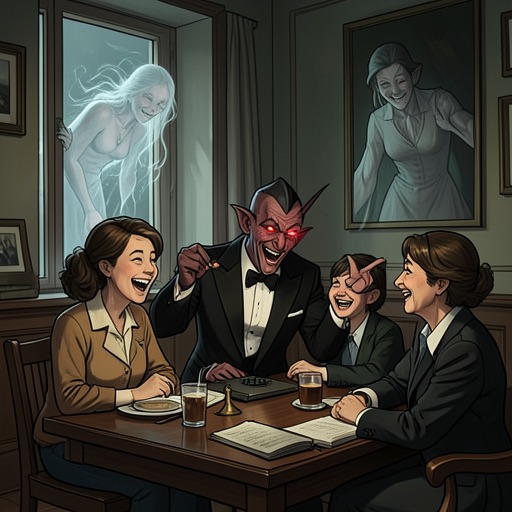
Deacon Brucke
A History of the Vampire in Popular CultureDeacon Brucke is the youngest of the vampire housemates in What We Do In The Shadows, though his age is measured in centuries rather than human years. At 183, he is still treated as the junior member of a household whose inhabitants have accumulated incompatible habits, loyalties, and historical identities. His decisive importance lies in the contrast between the moral enormity of his past and the banal, quarrelsome routine through which that past is presented: Deacon is a vampire, a former Nazi, a housemate, and an unexpectedly comic embodiment of the genre’s modern elasticity.
Identity and Background
Deacon lives with Viago von Dorna Schmarten Scheden Heimburg, Vladislav, and Petyr in a nondescript suburban house in Wellington, New Zealand. The film’s mockumentary form places him inside the ordinary rhythms of shared accommodation: arguments, jealousies, social anxieties, and efforts to preserve household order. The supernatural is not treated as an exceptional register reserved for grand castles or ancient curses. Instead, Deacon belongs to a group of outsiders quietly trying to manage everyday life while remaining undead.
His age makes him the youngest vampire in the group, but it does not make him innocent. He tells the camera that he was once a Nazi vampire during the Second World War, and the confession is delivered with wry bemusement rather than moral self-examination. The remark does not erase the violence of the identity; it exposes the film’s deliberately confused moral code, in which centuries of murder and political atrocity can be folded into the awkward disclosures of a housemate. Deacon’s past is therefore both a joke and a provocation: the comic treatment makes the character more absurd, but also makes the normalization of monstrous history impossible to overlook.
Household Life and Relationships
Deacon’s relationship with Petyr combines familial attachment with an explicitly vampiric hierarchy. Petyr is the oldest vampire in the group and Deacon’s sire, the figure who created him by forcing him to drink vampire blood at the point of death. Deacon recounts the transformation as a grotesque personal anecdote, complete with Petyr’s attack, the bite to his neck, and the theatrical image of the older vampire opening his wings and screeching above him. The scene’s joke depends on the gap between the horror of forced transformation and the cheerful tone of a family reunion.
That family structure becomes painfully clear when Petyr is killed by a vampire hunter. The hunter was accidentally alerted to the vampires’ presence by Nick, the newest and least wanted member of the household. Deacon, Viago, and Vladislav are genuinely heartbroken by Petyr’s death, while Deacon’s jealousy toward Nick resembles the resentment of an older sibling forced to accommodate an unwanted younger arrival. The supernatural family is thus governed by recognizably human emotions: grief, possessiveness, irritation, and the fear that a new member will displace an established bond.
The household’s social life also includes ritualized antagonism toward the local werewolf pack. The vampires provoke the werewolves as though they were bored teenagers picking fights with rival gangs, while the werewolves answer with the motto, “We’re werewolves, not swear-wolves.” Deacon participates in a world where centuries-old predators are reduced to neighborhood rivalries, and where the threat of supernatural violence coexists with the petty conventions of adolescent mischief.
Performance and Comic Construction
Deacon’s comedy depends less on an elaborate biography than on a sharply legible combination of traits. Jonny Brugh described the character as both sexy and nerdy, a combination expressed through knitting and erotic dance. Those details make Deacon difficult to classify within the traditional vampire spectrum. He is neither the purely threatening revenant represented by Count Orlok in Nosferatu nor the elegant, emotionally predatory figure associated with Carmilla and later literary vampires. His appeal comes from the collision of seduction, awkwardness, craft, and bodily theatricality.
Brugh said that Deacon was not an interpretation imposed on an already fixed character but an invention brought to the shoot: Deacon was an alter ego, a version of the performer suppressed in ordinary life so as not to offend other people. The writers deliberately did not know what he would do and asked him to surprise them. This method helps explain the character’s unstable, improvisational energy. Deacon does not seem to be executing a solemn Gothic persona; he is discovering what that persona becomes when played as an unruly social self.
The production’s hidden-script approach reinforced that effect. Actors were given enough purpose to understand a scene but were not overprepared with every line and reaction. Brugh emphasized that overly rehearsed performers might stop listening and playing, whereas the film’s humor emerges from confusion, responsiveness, and the ability to adapt in the moment. Deacon’s characterization consequently appears as a social performance in the fullest sense: his personality is produced through encounters, surprises, and the comic pressure of other people’s reactions.
Place in Vampire History and Genre Change
Deacon belongs to a long transformation in vampire representation. Earlier traditions centered on revenants, folkloric predators, and feared corpses, while nineteenth-century fiction increasingly established the night creature as elegant, selective, and erotically charged. Varney introduced sharpened, fang-like teeth into a form that helped shape later expectations, and Carmilla developed the nocturnal predator into an emotionally and physically sophisticated figure. Count Orlok preserved a more threatening, non-erotic appearance in Nosferatu, while later adaptations made Dracula’s public image increasingly charismatic and recognizable.
Modern portrayals, however, allow vampires to be almost anything. They may be sympathetic, politically visible, romantically idealized, openly monstrous, or comic. Deacon represents the comic end of that expansion without ceasing to be dangerous. His domestic setting and awkward habits do not humanize vampirism into harmlessness; the group still has a history of killing, feeding, and treating mortals as expendable. Instead, the film relocates the vampire into a social environment where monstrosity must coexist with etiquette, jealousy, grief, and household inconvenience.
That shift also connects Deacon to the broader rise of goth culture, which emerged from post-punk clubs in Britain in the early 1980s and turned undead imagery into a durable music, fashion, and identity culture. The vampire no longer belongs only to supernatural fiction. It can circulate through performance, costume, music, comedy, and self-conscious subculture. Deacon’s knitting, erotic dancing, and improvised self-display turn the old creature of the night into a figure who can be watched, interviewed, and understood through style as much as through predation.
Narrative Significance
Deacon’s significance comes from the film’s refusal to separate the extraordinary from the routine. He is a Nazi vampire, yet he is also the youngest member of an irritable household; he is a killer, yet he can be jealous of a new sibling and devastated by the death of his sire; he is meant to be sexy, yet his sex appeal is paired with nerdiness and knitting. These contradictions are not resolved into a moral lesson. They are sustained as the comic mechanism through which the film examines what happens when the vampire’s ancient identity is forced into modern social life.
He therefore helps make What We Do In The Shadows a parody of vampire conventions without reducing the genre to a joke. Deacon’s history retains the violence of vampirism, while his behavior exposes the habits and poses by which vampire fiction has traditionally made that violence attractive. The result is a character who is funny because he is ordinary, unsettling because his ordinariness contains atrocity, and memorable because his performance turns the ancient outsider into a person who must still find a place in the household.